

Reusable Filters and Energy Savings: Connection
A reusable furnace filter can cut waste, but washing it doesn’t guarantee lower energy bills. I’d start by checking its fit and pressure drop at your HVAC system’s airflow - not its MERV rating alone.
Here’s my checklist before buying or switching:
- Check compatibility: Confirm exact dimensions, airflow direction, and pressure-drop limits. For ElectroDust, review product data, cleaning instructions, warranty, and return terms.
- Keep airflow steady: Inspect monthly, wash as directed, and let the filter dry completely before reinstalling it.
- Compare total costs: Count purchases, shipping, washing, drying, and replacement - not just the price tag.
- Check the results: Track energy use under similar weather and thermostat settings. Keep HVAC emissions separate from the filter’s manufacturing, cleaning, and disposal footprint.
My bottom line: choose reusable or disposable based on filtration, airflow, upkeep, and total cost. Less discarded material is one gain; lower energy use needs measurements.
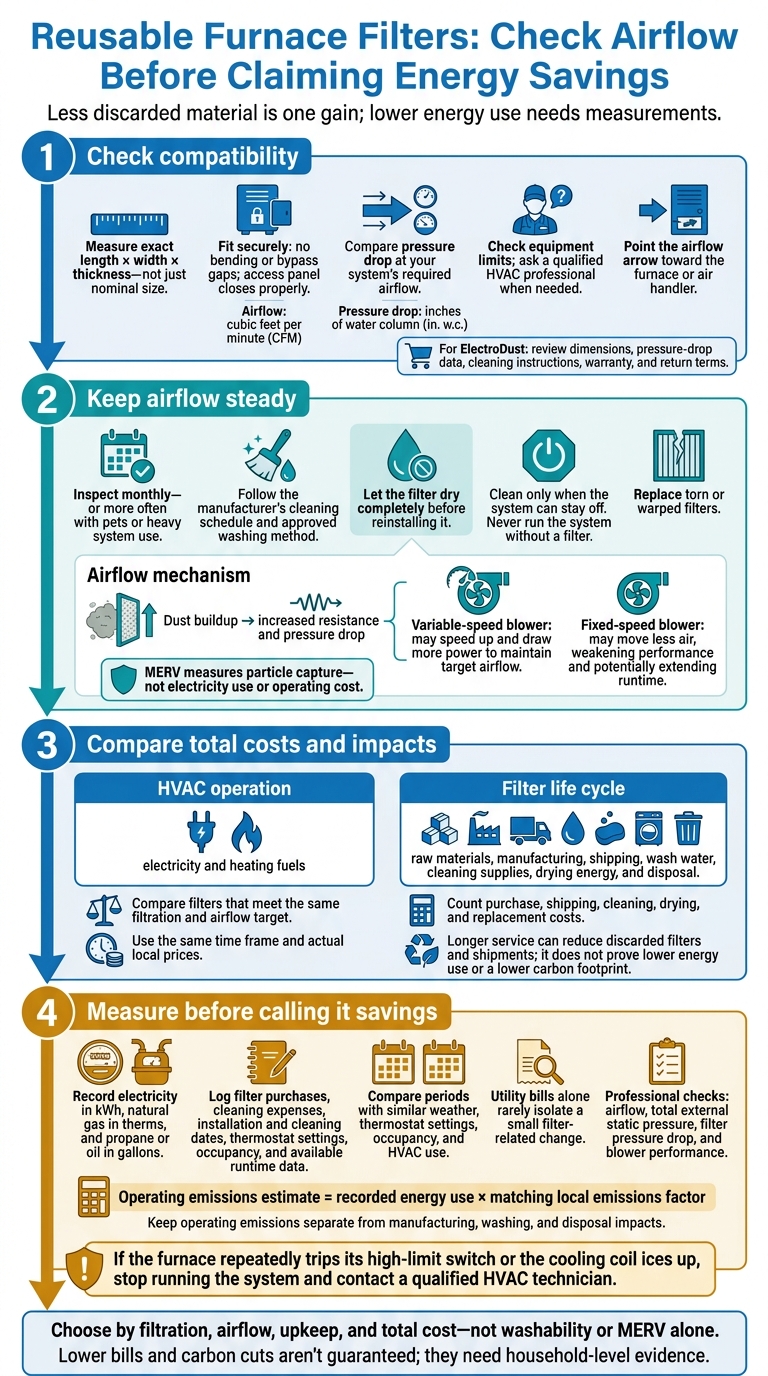
Reusable Furnace Filters: Check Airflow Before Claiming Energy Savings
The Problem: Restricted Airflow Can Increase Energy Use
How Dust Buildup Affects Airflow
As dust collects on a filter, resistance and pressure drop increase. A variable-speed blower may speed up and draw more power to maintain target airflow. A fixed-speed blower may move less air instead. That reduced airflow can weaken heating or cooling performance and make the system run longer.
Watch for weak airflow from vents, uneven temperatures, unusual blower noise, or longer cycles. These signs can also point to duct or equipment problems. If the furnace repeatedly trips its high-limit switch or the cooling coil ices up, stop running the system and have a qualified HVAC technician measure airflow and total external static pressure.
Pressure drop tells you more than MERV alone about how a filter may affect energy use.
Why MERV Ratings Do Not Measure Energy Efficiency
MERV measures particle capture - not electricity use or operating cost. Two filters with the same MERV rating can have different pressure drops because their thickness, surface area, and construction differ.
Compare pressure-drop specifications at your system’s required airflow, typically expressed in cubic feet per minute (CFM). Pressure drop is usually measured in inches of water column (in. w.c.). Check those specifications alongside filter dimensions and equipment limits. A pressure-drop figure measured at a different airflow does not prove that a filter will work with your system.
The next step is to match the filter’s pressure drop to your system’s requirements.
sbb-itb-adeab55
The Solution: Choose and Maintain a Compatible Reusable Filter
Check Filter Size, Pressure Drop, and Installation
To avoid wasting energy, match the filter to your system - not just the slot.
Measure the filter slot’s exact length × width × thickness. The printed nominal size is a label, not the actual measurement. Your replacement should fit securely without bending or leaving gaps that let air bypass the filter. The access panel must also close properly.
Check the filter’s pressure drop at your system’s operating airflow, both when clean and when loaded with dust. Compare those readings with the equipment’s allowable static pressure limit, or ask a qualified HVAC professional to check compatibility. During installation, point the airflow arrow toward the furnace or air handler and seat the frame fully in its tracks.
A compatible, low-resistance filter helps maintain airflow and avoid excess energy use. But fit is only part of the job: cleaning keeps resistance from climbing.
Follow Cleaning and Drying Instructions
Inspect the filter monthly, or more often if you have pets or use the system heavily. Follow the manufacturer’s cleaning schedule and approved washing method. Clean it before buildup increases resistance. Regular cleaning helps preserve airflow, avoiding unnecessary runtime and the emissions that come with it.
Let the filter dry completely before reinstalling it. Only clean it when the system can stay off, and never run the system without a filter. Replace any filter that’s torn or warped.
Review ElectroDust Specifications Before Buying
Before buying ElectroDust, check its specifications against your system’s requirements. Confirm the exact dimensions, pressure-drop data at the airflow rates your system uses, cleaning instructions, warranty terms, and return requirements.
Reusability reduces waste, but it doesn’t guarantee energy savings or complete allergen removal.
Assess Energy Use, Carbon Footprint, and Costs
Separate HVAC Emissions From Filter Life-Cycle Impacts
Once fit and airflow are correct, compare each filter’s full impact.
HVAC operating emissions and filter life-cycle impacts are separate. HVAC emissions come from electricity and heating fuels, such as natural gas, propane, or oil. A filter’s footprint includes raw materials, manufacturing, shipping, wash water, cleaning supplies, drying energy, and disposal.
A longer service life can reduce waste and shipments. But that alone doesn’t prove a lower carbon footprint. Neither does a lower purchase price - and less waste doesn’t guarantee lower energy use.
Compare Reusable and Disposable Filter Needs
Compare filters that meet the same filtration and airflow target. Energy use depends on resistance, HVAC design, blower controls, operating hours, climate, and maintenance - not just whether a filter is washable.
Look at pressure drop, maintenance needs, and total cost. Compare the total impact, rather than judging a filter by washability or MERV alone.
| Factor | Compatible reusable filter | Compatible disposable filter |
|---|---|---|
| Airflow resistance | Compare pressure drop at the same operating airflow. | Compare pressure drop at the same operating airflow. |
| Maintenance and service life | Wash, dry, and inspect; durability depends on care and damage. | Inspect; replace based on loading and guidance. |
| Replacement waste | Longer service means fewer discarded filters. | Regularly discarded filters and packaging. |
| Wash water and cleaning supplies | Required; drying may also use energy. | No routine washing needed. |
| Costs | Purchase, shipping, cleaning, drying, and replacement. | Repeat purchases, shipping, and disposal. |
Use the same time frame and actual local prices. Include purchase, shipping, cleaning, drying, and replacement costs. Track measured HVAC energy changes separately so you don’t mistake lower filter-purchase costs for energy savings.
Track Household Energy Use and Filter Costs
Track energy use and filter costs over the same period to separate actual savings from normal variation.
Record electricity in kWh, natural gas in therms, and propane or oil in gallons. Log filter purchases, cleaning expenses, installation and cleaning dates, thermostat settings, occupancy, and any available runtime data. Compare periods with similar weather, thermostat settings, occupancy, and HVAC use.
Utility bills alone rarely isolate a small filter-related change. An HVAC professional can measure airflow, total external static pressure, filter pressure drop, and blower performance.
To estimate operating emissions, multiply recorded energy use by your local emissions factor, making sure the units match. Keep this estimate separate from manufacturing, washing, and disposal impacts.
If airflow changes, verify the energy effects with measurements before calling them savings.
Conclusion: Maintain Airflow and Reduce Filter Waste
Reusable filters save energy only when airflow stays within spec. Check fit and pressure drop first - not savings claims.
Clean the filter on schedule, and replace it when it no longer fits or performs correctly. Regular maintenance helps preserve airflow, but you’ll need measured household data to know whether it also lowers emissions and costs.
Reusable filters can cut replacement waste and help maintain HVAC performance. Lower bills and carbon cuts aren’t guaranteed; they need household-level evidence. To reduce carbon emissions, energy savings over the filter’s full service life must outweigh the impacts of manufacturing, cleaning, drying, and disposal.
FAQs
How can I verify filter-related energy savings?
Watch your utility bills for savings: a clean filter can cut energy use by 5% to 15%. Also, check that airflow from your vents stays steady and your HVAC cycles last their usual length. Longer cycles, trouble keeping your home at the set temperature, or unusually high energy bills likely mean your filter needs cleaning.
Check for dust monthly and deep-clean every 1 to 3 months to keep your system running efficiently and avoid wasting energy.
When does a reusable filter offset its carbon footprint?
A reusable filter offsets its carbon footprint when energy savings and less landfill waste from avoiding repeated single-use filter purchases and disposal outweigh the impact of making it.
According to ElectroDust’s materials, savings begin after about 10 months of use. The filter then continues to save energy and reduce its impact over several years - often up to a decade.
How do I calculate a reusable filter’s payback period?
Compare the reusable filter’s upfront price with the cost of disposable replacements over the same period. The payback period is the time it takes for those disposable costs to equal the reusable filter’s purchase price.
Most homeowners reach that point within 12 to 18 months. Some start saving as early as 8 to 10 months, depending on how much they spend on disposable filters each year.